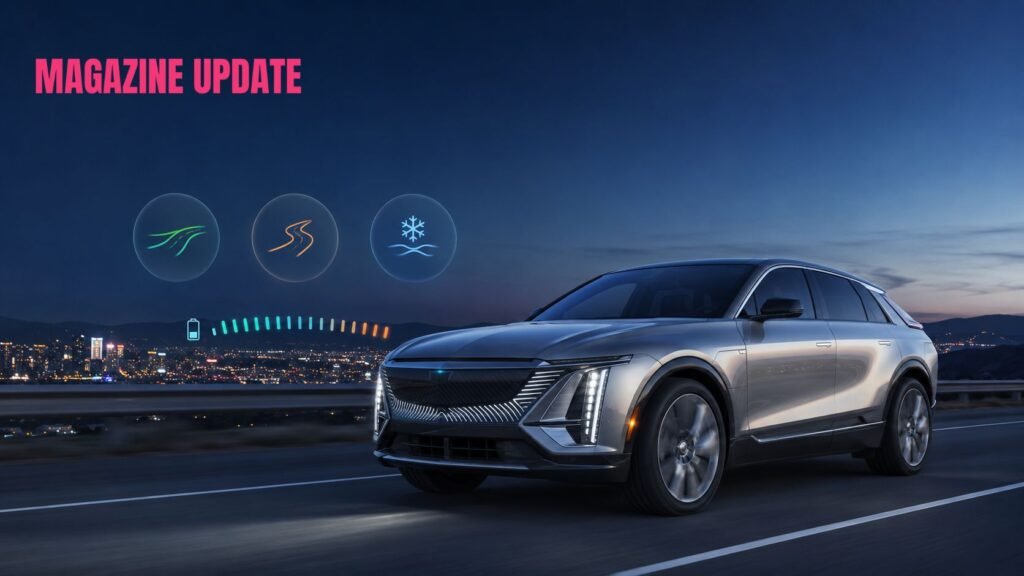

Do the driving modes in Cadillac LYRIQ offer different ranges or battery usages? In practical terms, yes—but not because each mode unlocks a separate battery capacity or comes with its own official mileage rating. The LYRIQ uses the same battery energy regardless of whether Tour, Sport, Snow/Ice, or My Mode is selected. What changes is how the vehicle responds to the driver and, in some cases, how systems such as steering and braking are calibrated.
Those changes can influence electricity consumption indirectly. Sport mode’s sharper accelerator response may encourage quicker acceleration, while Snow/Ice mode softens torque delivery to reduce wheelspin. Tour is designed for smooth everyday driving and is generally the sensible choice when efficiency matters.
The important distinction is between a mode’s programming and the way the car is driven. Selecting Sport does not immediately remove a fixed number of miles from the battery. Likewise, Snow/Ice is not an economy mode that guarantees extra range. Speed, temperature, acceleration, terrain, climate control, tires, and driving habits usually have a much greater effect.
What the LYRIQ’s Drive Modes Actually Change
The regular Cadillac LYRIQ has four principal driving modes, although exact features can vary by model year, trim, equipment, and software version.
| Driving mode | Main purpose | Likely effect on energy use |
|---|---|---|
| Tour | Smooth, balanced everyday driving | Usually the most efficient and predictable choice |
| Sport | Quicker torque response and a more connected feel | Can increase consumption if it encourages harder acceleration |
| Snow/Ice | Softer torque delivery to reduce wheelspin | No guaranteed range improvement; designed for traction |
| My Mode | Personalized accelerator, steering, braking, and sound settings | Depends on the settings selected and how they affect driving behavior |
Tour is the LYRIQ’s normal everyday setting. Cadillac describes it as being calibrated for a smooth ride, and the company’s broader guidance identifies Tour or Normal as the most economical setting for regular use. It does not severely limit power. Instead, it provides a progressive, manageable response that makes smooth acceleration easier.
Sport sharpens the experience. In the LYRIQ, it provides more immediate torque response, changes steering feel, and creates a stronger sense of connection to the road. The battery and motors remain capable of operating efficiently, but the accelerator’s sharper response makes it easier to request more power with a smaller pedal movement.
Snow/Ice changes the accelerator mapping in the opposite direction. It slows the delivery of acceleration and torque to help prevent wheelspin on slippery surfaces. Its purpose is stability and control, not maximum efficiency.
My Mode allows the driver to combine preferred settings. Depending on the vehicle’s configuration, these can include accelerator responsiveness, steering feel, braking response, and Electric Vehicle Sound Enhancement. A mild accelerator setting paired with comfortable steering could behave much like Tour. A more aggressive accelerator calibration could feel closer to Sport.
The high-performance LYRIQ-V adds its own performance-focused features, including V-Mode and Velocity Max. Those should not be confused with the standard LYRIQ’s regular modes. Using the LYRIQ-V’s maximum-performance settings repeatedly is far more likely to raise energy consumption because they make its substantial power easier to access.
Do the Driving Modes in Cadillac LYRIQ Offer Different Ranges?
Cadillac does not publish a separate EPA-estimated range for Tour, Sport, Snow/Ice, and My Mode. The official estimate is assigned to the vehicle configuration tested, not to every selectable mode.
That configuration matters. A single-motor rear-wheel-drive LYRIQ can have a different official range from a dual-motor all-wheel-drive version. Wheel and tire choices, performance equipment, and model-year changes can also affect the rating. Recent LYRIQ versions have been advertised with official estimates extending beyond 300 miles in some configurations, while the more powerful LYRIQ-V carries a lower rating.
These are differences between vehicles or equipment combinations—not proof that changing an on-screen drive mode permanently changes the battery’s usable capacity.
The range displayed in the vehicle is also an estimate rather than a promise. It considers factors such as recent consumption and current operating conditions. If a driver spends an afternoon accelerating hard in Sport mode, the estimated remaining mileage may fall more quickly. Returning to Tour and driving gently may eventually cause the prediction to improve.
That does not mean the vehicle has recovered energy simply by changing modes. It means the range calculation has adapted to a lower rate of electricity use.
Why Sport Mode Can Use More Battery
An electric motor can produce high torque almost immediately. Rapid acceleration requires a large burst of electrical power, and repeatedly requesting those bursts consumes more energy than building speed gradually.
Sport mode makes the LYRIQ feel more responsive, but the mode itself is not constantly draining the battery at an unusually high rate. If a driver maintains a steady 55 mph on level ground, the difference between Tour and Sport may be modest. Aerodynamic drag, tire resistance, and accessory loads dominate during that kind of cruising.
The difference becomes clearer in stop-and-go driving or on a winding road. A sensitive accelerator can encourage the driver to accelerate harder after every slowdown. Energy can be recovered during regenerative braking, but regeneration cannot return all the electricity used to accelerate. Some energy is inevitably lost through heat, electrical resistance, tire deformation, and other inefficiencies.
Sport mode may therefore reduce real-world range when it changes driving behavior. How large the reduction is cannot be stated accurately as a universal percentage. It depends on the route, speed, weather, traffic, and driver.
Snow/Ice Mode Is About Grip, Not Extra Miles
Snow/Ice mode can feel more economical because it reduces the initial torque response. On dry roads, that softer response might help an aggressive driver accelerate more gently. Even so, it should not be treated as a dedicated efficiency setting.
Winter conditions usually introduce several major range penalties at the same time. A cold battery is less efficient, cabin heating requires energy, and snow or slush increases rolling resistance. Winter tires may also consume slightly more energy than efficiency-focused all-season tires.
Preventing unnecessary wheelspin can avoid wasting some power, but that benefit is unlikely to cancel the broader effects of cold weather. A LYRIQ operating in Snow/Ice mode on a freezing day may consume considerably more battery than the same vehicle in Tour mode during mild weather.
Cadillac also advises against relying on One-Pedal Driving in slippery conditions. Strong deceleration at the driven wheels may not be desirable when grip is limited. Snow/Ice mode and careful pedal control are primarily safety tools.
My Mode Can Be Efficient or Aggressive
My Mode does not have one predictable effect because it is configurable. The resulting battery usage depends on which characteristics the driver chooses.
Accelerator responsiveness is the most relevant setting. A gentler response can make it easier to accelerate smoothly, while a sharper response can encourage larger power demands. Steering weight usually has little direct impact on range. Changes to brake feel may influence how naturally the driver slows down, although the vehicle’s regenerative and friction-braking systems still manage the actual deceleration.
Electric Vehicle Sound Enhancement may require a small amount of electrical energy through the audio system, but it is not likely to be a meaningful range factor compared with propulsion, cabin heating, or highway speed.
A range-conscious My Mode would generally use a progressive accelerator response and settings that encourage smooth inputs. Still, it is unlikely to create dramatic savings over well-driven Tour mode.
Regenerative Braking and One-Pedal Driving
Regenerative braking allows the LYRIQ’s electric motor to act as a generator while the vehicle slows, returning some energy to the battery. One-Pedal Driving makes this process easier to access by slowing the vehicle when the driver lifts off the accelerator. Cadillac provides different levels of one-pedal deceleration on supported vehicles.
More aggressive regeneration does not automatically produce more range. The most efficient approach is often to preserve momentum and avoid unnecessary acceleration or braking. Regeneration is useful when the vehicle must slow, but coasting smoothly can be better than repeatedly accelerating and regenerating.
The advantage of One-Pedal Driving is consistency. In urban traffic, it can help a driver slow progressively and reduce reliance on friction braking, which converts motion into unrecoverable heat. On an open highway with steady traffic, its effect on consumption may be small.
Drivers should also remember that regenerative braking may be limited when the battery is very full, very cold, or otherwise unable to accept as much charging power. The vehicle can blend in its conventional brakes when necessary.
What Has a Bigger Effect Than the Selected Mode?
For most owners, several factors matter more than whether Tour or Sport appears on the display.
Highway speed is one of the largest. Air resistance rises rapidly as speed increases, so driving at 75 or 80 mph can use noticeably more electricity than traveling at a moderate speed. Drive mode cannot overcome that aerodynamic demand.
Cabin temperature is another major influence, particularly in winter. Heating the interior and conditioning the battery require energy. Preconditioning the LYRIQ while it is plugged in can move some of that demand to the charging source before departure.
Other significant factors include:
- Repeated hard acceleration
- Cold or extremely hot weather
- Strong headwinds
- Long or steep climbs
- Low tire pressure
- Heavy cargo or trailer towing
- Snow, standing water, or poor road surfaces
- Roof-mounted accessories that increase drag
Air conditioning, seat heating, electronics, and lighting also use power, but propulsion and temperature management generally account for the more noticeable changes.
Choosing a Mode When Range Matters
Tour is the straightforward choice for commuting and long-distance travel. Its smooth accelerator calibration makes measured driving easier, and it is the mode Cadillac intends for normal use.
Sport is reasonable when a driver wants quicker response, but it should be used with realistic expectations. Selecting it does not make long-distance travel impossible; repeatedly exploiting its sharper performance is what consumes additional energy.
Snow/Ice should be selected when road conditions justify it. Preserving traction and maintaining control are more important than chasing a small theoretical efficiency advantage.
My Mode is useful for drivers who want a particular steering or braking feel without necessarily adopting the full Sport calibration. Owners concerned about range can keep the accelerator response on a gentler setting while personalizing less energy-sensitive controls.
For a longer journey, the most effective strategy is simple: start with an appropriate charge, use Tour, maintain moderate speeds, keep tires properly inflated, precondition while connected, and plan charging stops with a reserve for weather or elevation changes.
Conclusion
So, do the driving modes in Cadillac LYRIQ offer different ranges or battery usages? They can produce different real-world energy consumption, but they do not provide separate batteries, fixed mileage allowances, or mode-specific EPA range ratings. Tour is usually the best setting for consistent efficiency. Sport can consume more energy when its sharper response leads to stronger acceleration, while Snow/Ice prioritizes traction rather than extending range. My Mode can lean in either direction depending on its configuration.
Ultimately, the driver’s inputs and operating conditions matter more than the mode label. Smooth acceleration, sensible highway speeds, good tire pressure, and careful climate use will do more for LYRIQ range than repeatedly switching between drive settings.
Frequently Asked Questions
Does Sport mode immediately reduce the LYRIQ’s available range?
No. It does not remove battery capacity, but its sharper accelerator response can increase consumption if the driver accelerates more aggressively.
Is Tour mode the most efficient LYRIQ setting?
Generally, yes. Tour is intended for smooth everyday operation and is Cadillac’s recommended economical mode.
Does Snow/Ice mode increase range?
Not necessarily. It softens torque delivery to reduce wheelspin, but cold temperatures, heating, snow, and winter tires can still reduce overall range.
Can My Mode be configured to save battery?
A gentle accelerator setting may encourage efficient driving, but My Mode is not a dedicated economy mode and does not guarantee greater range than Tour.
Does One-Pedal Driving always improve efficiency?
It can help recover energy during necessary slowing, especially in city traffic. However, maintaining momentum and avoiding unnecessary acceleration and braking is usually more efficient than relying on strong regeneration.
Also read :About Aelftech Com: Services, Website Content, and What to Verify